Choosing the Right Data Acquisition System for Industrial Applications

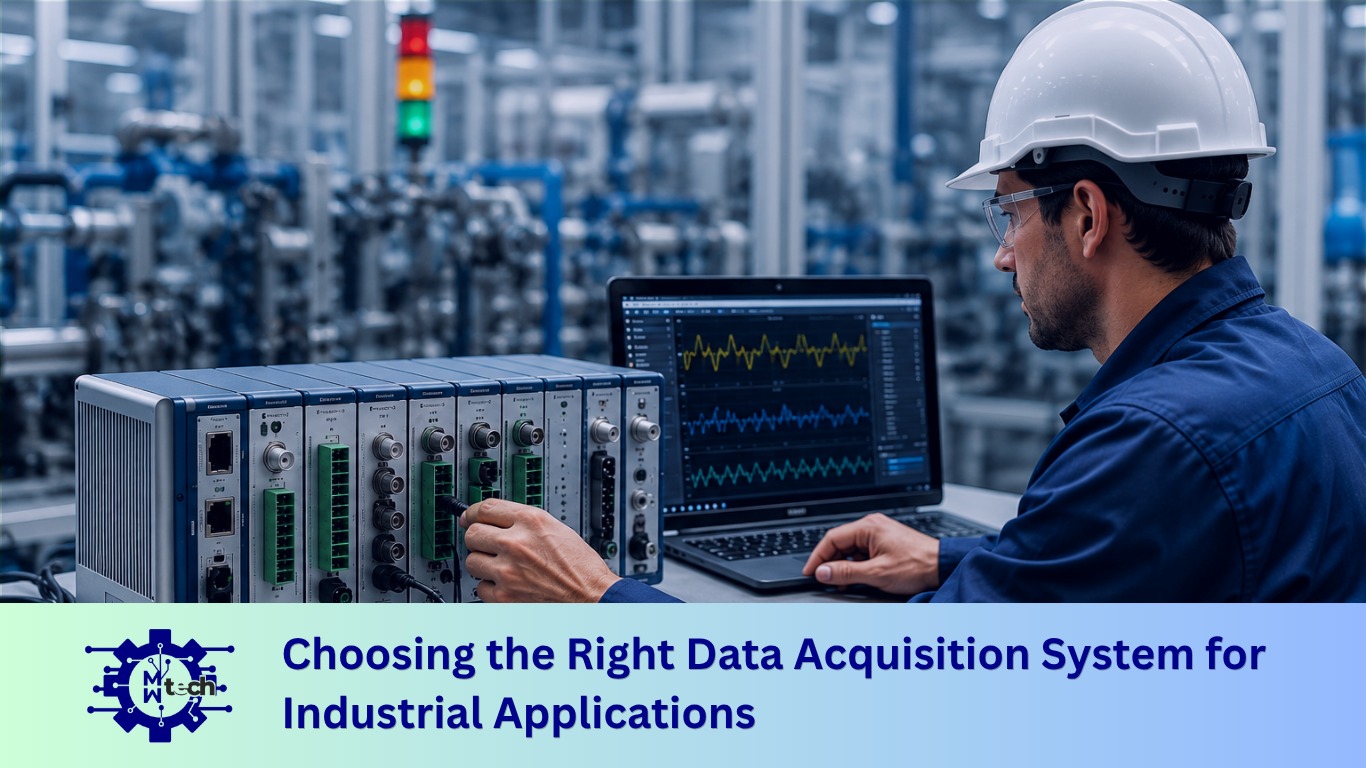
With today’s rapid changes in the industrial sector, gathering accurate data is important for increasing productivity, enhancing product quality, ensuring machinery uptime, and streamlining automation processes.
Real-time monitoring and analysis are integral parts of modern industrial manufacturing plants in order to optimize machinery performance and automate manufacturing processes.
This is when data acquisition systems become crucial.
Electronics manufacturing, automotive assembly lines, aerospace engineering, pharmaceuticals, semiconductors, and power and energy generation companies implement industrial data acquisition systems to gather and analyze data from machinery, sensors, and other test instruments.
It may seem complicated to select the appropriate data acquisition system depending on your company’s specific industrial data acquisition application.
This article will help you understand how industrial data acquisition systems work, what to consider when selecting a system, applications of industrial DAQ systems, and how to select the proper data acquisition system.
What Is a Data Acquisition System?
A Data Acquisition System (DAQ system) is a combination of hardware and software used to collect, measure, monitor, and analyze real-world signals from industrial equipment and sensors.
DAQ systems convert physical signals such as:
- Temperature
- Voltage
- Current
- Pressure
- Vibration
- Strain
- Speed
- Flow rate
into digital data that can be monitored, processed, and analyzed in real time.
These systems are widely used in:
- Industrial automation
- Product testing
- Research & development
- Predictive maintenance
- Machine monitoring
- Smart factory systems
- Process validation
Why Industrial Data Acquisition Matters
Modern manufacturing environments generate massive volumes of operational data every second.
Without proper monitoring systems, manufacturers may struggle with:
- Equipment failures
- Quality issues
- Production inefficiencies
- Downtime
- Compliance challenges
- Energy wastage
Industrial DAQ systems provide real-time visibility into machine performance and operational conditions, helping businesses make data-driven decisions.
They are essential for:
- High-speed monitoring
- Automated testing
- Condition monitoring
- Process optimization
- Predictive analytics
- Reliability engineering
How Data Acquisition Systems Work
A typical industrial DAQ system consists of several key components:
1. Sensors and Transducers
Sensors measure physical parameters such as temperature, vibration, pressure, or electrical signals.
These sensors convert real-world conditions into measurable electrical outputs.
2. Signal Conditioning
Raw sensor signals often require amplification, filtering, or isolation before processing.
Signal conditioning ensures data accuracy and improves measurement quality.
3. DAQ Hardware
DAQ hardware collects and digitizes sensor signals.
This may include:
- Modular DAQ systems
- High-speed data loggers
- Embedded controllers
- USB/Ethernet DAQ devices
- Industrial monitoring hardware
4. Data Processing Software
Software platforms help visualize, store, analyze, and report data.
Advanced systems may include:
- Real-time dashboards
- Alarm systems
- Analytics tools
- SCADA integration
- Cloud monitoring
- AI-based analysis
Key Factors to Consider When Choosing a Data Acquisition System
Selecting the right DAQ system depends on your industry requirements, application complexity, and operational goals.
Here are the most important factors manufacturers should evaluate:
1. Sampling Speed and Data Rate
One of the most critical factors is how fast the system can capture data.
Some applications require low-frequency monitoring, while others need ultra-high-speed acquisition.
For example:
- Environmental monitoring may require 1 Hz sampling
- Vibration analysis may require kHz-level sampling
- Semiconductor or aerospace testing may require MHz-level acquisition
High-speed applications demand advanced DAQ systems capable of capturing transient events accurately.
2. Number of Input Channels
Industrial applications often involve monitoring multiple sensors simultaneously.
Before selecting a system, manufacturers should determine:
- Current channel requirements
- Future scalability needs
- Distributed monitoring requirements
Scalable modular DAQ systems are ideal for growing manufacturing operations.
3. Signal Types Supported
Different applications use different signal types.
Ensure the DAQ system supports:
- Analog signals
- Digital signals
- Thermocouples
- RTDs
- Strain gauges
- Current loops
- Voltage inputs
- Pulse signals
Versatile systems improve integration flexibility across industrial environments.
4. Accuracy and Resolution
Precision is essential in industries such as aerospace, semiconductor manufacturing, pharmaceuticals, and electronics.
Higher-resolution DAQ systems provide more accurate measurements and better signal analysis.
Important specifications include:
- Bit resolution
- Measurement accuracy
- Noise performance
- Signal stability
Poor data accuracy can lead to incorrect analysis and costly production issues.
5. Real-Time Monitoring Capabilities
Modern manufacturing requires real-time visibility into operational conditions.
Choose systems capable of:
- Live data visualization
- Automated alerts
- Continuous monitoring
- Remote access
- Event-based triggering
Real-time monitoring supports predictive maintenance and process optimization.
6. Industrial Communication Protocols
Industrial environments often require integration with existing automation infrastructure.
The DAQ system should support common protocols such as:
- Modbus
- CAN Bus
- OPC UA
- Ethernet/IP
- ProfiNet
- MQTT
Protocol compatibility simplifies integration with PLCs, SCADA systems, IoT platforms, and enterprise software.
7. Environmental Conditions
Industrial environments can be harsh.
Consider operating conditions such as:
- Temperature extremes
- Dust exposure
- Humidity
- Vibration
- Electrical noise
Rugged industrial-grade DAQ systems are essential for reliable long-term operation.
8. Data Storage and Cloud Connectivity
Manufacturers increasingly rely on cloud-based analytics and remote monitoring.
Modern DAQ systems should support:
- Local data storage
- Edge computing
- Cloud integration
- Remote dashboards
- Historical data analysis
Cloud-enabled systems improve accessibility and centralized monitoring.
9. Software Integration and Analytics
A powerful DAQ system should integrate seamlessly with:
- SCADA systems
- MES platforms
- ERP software
- Industrial automation software
- AI analytics platforms
Integrated software ecosystems improve operational intelligence and decision-making.
Industry Applications of Data Acquisition Systems
Electronics Manufacturing
DAQ systems help monitor:
- PCB testing
- SMT processes
- Automated testing systems
- Power electronics validation
High-speed acquisition ensures product reliability and quality control.
Aerospace & Defense
Aerospace applications require highly accurate data monitoring for:
- Structural testing
- Environmental simulations
- Flight systems
- Vibration analysis
Precision monitoring is critical for safety and compliance.
Automotive Industry
Automotive manufacturers use DAQ systems for:
- Engine testing
- EV battery testing
- Dynamometer systems
- Production automation
Real-time monitoring improves efficiency and product consistency.
Power & Energy Sector
DAQ systems support:
- Grid monitoring
- Turbine performance analysis
- Power quality testing
- Renewable energy systems
Reliable monitoring helps reduce operational risks.
Semiconductor Manufacturing
Semiconductor environments demand ultra-precise monitoring for:
- Thermal systems
- Vacuum systems
- Cleanroom conditions
- Wafer processing equipment
Even minor variations can affect production quality.
Pharmaceutical Industry
Pharmaceutical manufacturers use DAQ systems for:
- Environmental monitoring
- Compliance reporting
- HVAC monitoring
- Process validation
Accurate monitoring supports regulatory standards.
Common Mistakes to Avoid
When selecting a DAQ system, manufacturers often make mistakes such as:
- Choosing based only on cost
- Ignoring scalability
- Overlooking integration capabilities
- Underestimating sampling requirements
- Using non-industrial hardware
- Selecting incompatible software platforms
A poorly selected system can create long-term operational limitations.
Future of Industrial Data Acquisition
As Industry 4.0 adoption continues growing, data acquisition systems are becoming smarter and more connected.
Future trends include:
- AI-powered analytics
- Edge computing
- Cloud-native monitoring
- Wireless sensing
- Digital twins
- Machine learning integration
- Smart factory ecosystems
Manufacturers investing in scalable monitoring systems today will be better prepared for future industrial automation demands.
Conclusion
Choosing the right data acquisition system is essential for modern industrial operations.
The right DAQ solution can help manufacturers:
- Improve process visibility
- Reduce downtime
- Enhance product quality
- Enable predictive maintenance
- Support automation initiatives
- Build smarter manufacturing systems
Whether it is electronics, aviation, automobiles, pharmaceuticals, semiconductors, or energy, real-time monitoring and fast data acquisition systems have become an essential element of success in today’s industry.
MeasureMint Technologies offers state-of-the-art fast data acquisition systems, industrial monitoring solutions, factory automation, and automated technology solutions for use in harsh industrial environments.
If you are looking to replace your existing monitoring system or install new data acquisition systems, you can contact us for a personalized solution.