Automated Test Equipment: Cost, ROI & Implementation Guide for Manufacturers

What is Automated Test Equipment
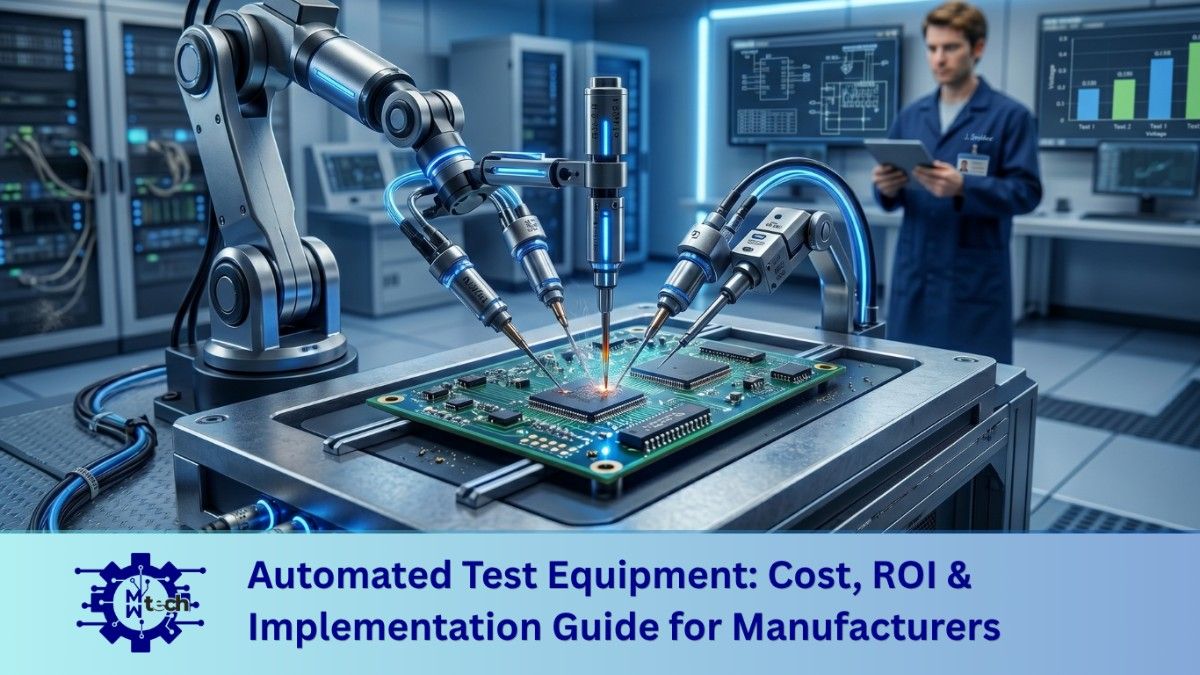
Automated Test Equipment (ATE) is a system that uses automation to test products or components, guaranteeing faster, more accurate, and reproducible results than manual testing. It is frequently utilized to increase efficiency and quality in the industrial, electronics, automotive, and pharmaceutical industries.
Why Manufacturers Are Moving Toward Automated Test Equipment
Manual testing creates:
- Inconsistent results
- High labor costs
- Slower production cycles
- Increased human error
ATE solves this by:
- Standardizing testing processes
- Reducing testing time by up to 70%
- Improving accuracy and traceability
- Enabling real-time data monitoring
Automated Test Equipment Cost Breakdown
The cost of automation test equipment depends on multiple factors:
1. System Complexity
- Basic systems: ₹5L – ₹15L
- Mid-level industrial systems: ₹15L – ₹50L
- Advanced custom ATE systems: ₹50L+
2. Customization Level
- Standard solutions → Lower cost
- Fully customized systems → Higher investment but better ROI
3. Integration Requirements
- PLC, SCADA, IoT integration increases cost but improves efficiency
4. Industry Type
- Pharma & electronics → Higher compliance & precision → Higher cost
ROI of Automated Test Equipment (Most Important Section)
1. Reduction in Labor Costs
Automation reduces dependency on manual operators → saves recurring costs
2. Increased Production Speed
Testing cycles become faster → higher output → more revenue
3. Error Reduction
- Manual testing error rate: High
- ATE error rate: Near zero
4. Data-Driven Decisions
Real-time data logging improves:
- Quality control
- Predictive maintenance
- Process optimization
Example ROI Scenario
| Factor | Before ATE | After ATE |
| Testing Time | 10 mins/unit | 2 mins/unit |
| Errors | High | Minimal |
| Labor Cost | ₹3L/month | ₹1L/month |
| Output | Low | 3X increase |
ROI is typically achieved within 6-18 months
Implementation Guide for Manufacturers
Step 1: Identify Testing Bottlenecks
- Where are delays happening?
- Where are errors highest?
Step 2: Define Testing Requirements
- Speed
- Accuracy
- Data logging needs
Step 3: Choose Between Standard vs Custom ATE
- Standard → Faster deployment
- Custom → Higher efficiency + long-term ROI
Step 4: System Integration
Ensure compatibility with:
- Existing machines
- Software systems
- Production workflows
Step 5: Deployment & Training
- Operator training
- System calibration
- Performance monitoring
Industries Using Automated Test Equipment
- Manufacturing
- Automotive
- Electronics
- Pharmaceutical
- Process industries
Common Mistakes to Avoid
- Choosing low-cost systems without scalability
- Ignoring integration capabilities
- Not planning for future expansion
- Lack of proper training
Ready to Implement Automated Test Equipment?
If you’re planning to:
- Reduce testing costs
- Improve production efficiency
- Eliminate manual errors
Call now to discuss a custom automated test solution tailored for your manufacturing needs.
FAQs
1. What is automated test equipment used for?
It is used for testing products automatically in manufacturing environments to improve speed and accuracy.
2. How much does ATE cost?
Costs range from ₹5L to ₹50L+ depending on complexity and customization.
3. Is ATE suitable for small manufacturers?
Yes, scalable solutions are available for small to large industries.
4. How long does implementation take?
Typically 4–12 weeks depending on system complexity.