
Understanding Test & Measurement Systems in Electronics Manufacturing

Introduction
Electronics manufacturing has evolved rapidly over the last decade. Products are becoming smaller, smarter, and more complex, while customer expectations for quality and reliability continue to increase. In such an environment, manufacturers cannot rely on assumptions when evaluating product performance. They need accurate data, reliable validation, and repeatable testing processes.
This is where Test & Measurement Systems play a crucial role.
From circuit board testing and component verification to product validation and quality assurance, test and measurement systems help manufacturers ensure that every product meets required specifications before reaching the customer.
Whether you are an electronics manufacturer in Gujarat, a production facility in India, or a global technology company, investing in the right testing infrastructure can significantly improve product quality, reduce failures, and enhance operational efficiency.
What Are Test & Measurement Systems?
Test & Measurement Systems are specialized solutions used to evaluate the performance, functionality, and reliability of electronic products and components.
These systems collect, analyze, and validate data related to electrical, mechanical, thermal, and environmental parameters.
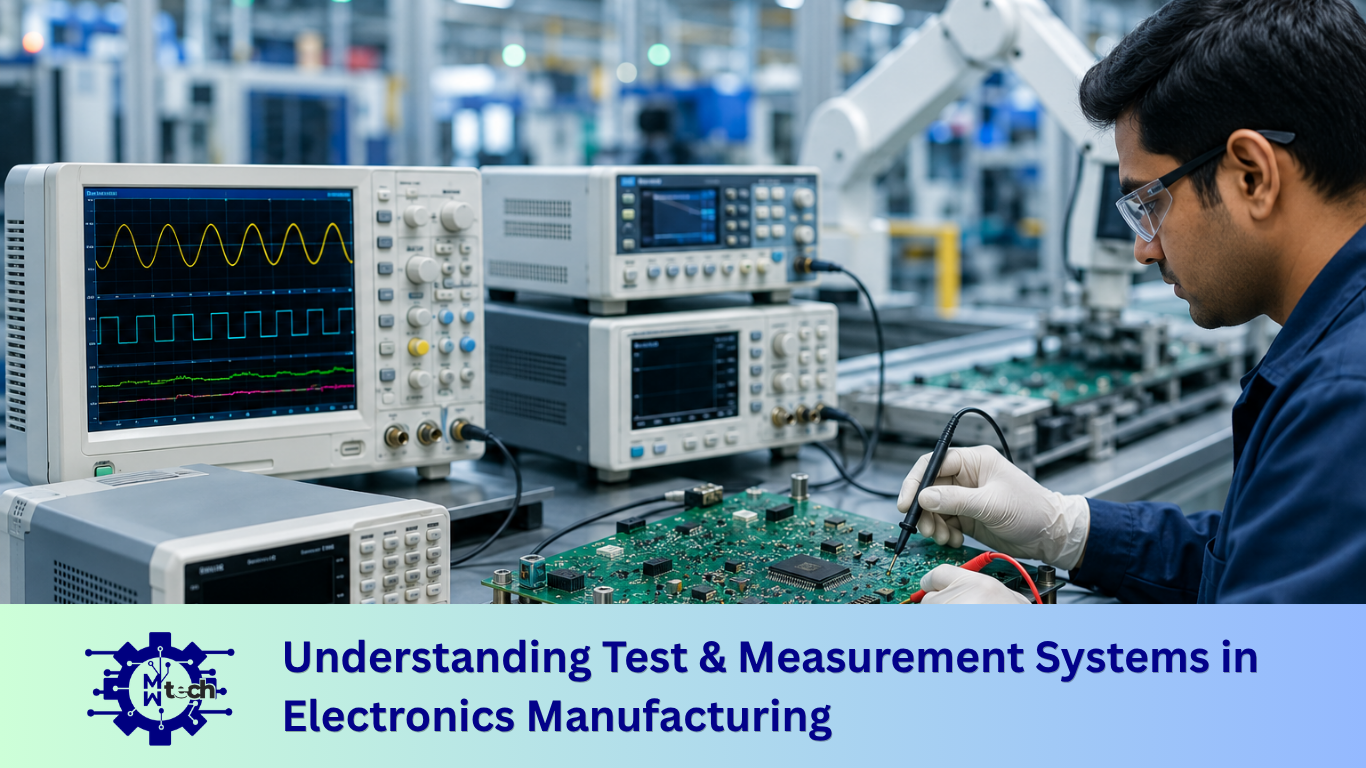
A typical test and measurement setup may include:
- Automated Test Equipment
- Data Acquisition Systems
- Digital Oscilloscopes
- Power Analyzers
- Signal Generators
- Data Logging Systems
- Environmental Monitoring Equipment
- Custom Validation Platforms
Together, these technologies provide engineers with accurate information that supports product development, manufacturing, and quality control.
Why Test & Measurement Systems Are Important
In electronics manufacturing, even a minor defect can result in product failures, warranty claims, customer dissatisfaction, and financial losses.
A reliable test and measurement system helps manufacturers:
- Verify product performance
- Identify defects early
- Improve product reliability
- Reduce manufacturing errors
- Accelerate product validation
- Support regulatory compliance
- Enhance customer confidence
Testing is no longer just a quality control process. It has become an essential part of product development and manufacturing strategy.
Key Applications in Electronics Manufacturing
Printed Circuit Board Testing
PCB assemblies are at the heart of most electronic products.
Test systems help manufacturers verify:
- Signal integrity
- Voltage levels
- Component placement
- Connectivity
- Functional performance
Accurate testing ensures that defects are identified before products move further into production.
Product Validation
Before a product reaches the market, it must undergo extensive validation.
Engineers use test and measurement systems to evaluate:
- Performance under different conditions
- Reliability over time
- Thermal behavior
- Power consumption
- Safety requirements
This process helps organizations launch products with greater confidence.
Production Line Testing
High volume manufacturing requires fast and repeatable testing.
Automated Test Equipment enables manufacturers to:
- Increase testing speed
- Reduce manual intervention
- Improve consistency
- Minimize human error
This improves overall manufacturing efficiency.
Research and Development
Innovation depends on accurate data.
Research teams use advanced measurement systems to:
- Evaluate prototypes
- Collect performance data
- Validate design assumptions
- Improve product designs
Reliable testing supports faster innovation cycles.
The Role of Automated Test Equipment
Automated Test Equipment has become a critical component of modern electronics manufacturing.
Instead of relying on manual procedures, automated systems execute predefined testing sequences automatically.
Benefits include:
Improved Accuracy
Automated systems eliminate many common human errors.
Faster Testing
Large production volumes can be tested efficiently.
Better Repeatability
Every product is evaluated using the same criteria.
Detailed Reporting
Engineers gain access to valuable testing data that supports quality improvement.
Organizations across India and global markets are increasingly investing in Automated Test Equipment to maintain competitiveness and improve product quality.
How Data Logging Supports Electronics Manufacturing
Modern manufacturing generates large amounts of information.
Data logging systems help manufacturers capture and analyze:
- Temperature
- Voltage
- Current
- Pressure
- Vibration
- Environmental conditions
This information supports:
- Predictive maintenance
- Process optimization
- Quality assurance
- Root cause analysis
Accurate data helps organizations make informed engineering decisions.
Common Challenges in Electronics Testing
Many manufacturers face challenges such as:
Increasing Product Complexity
Modern electronics require more advanced testing procedures.
Shorter Development Cycles
Products must reach the market faster without compromising quality.
Regulatory Compliance
Manufacturers must meet industry standards and certifications.
Data Management
Large amounts of testing information need to be collected and analyzed efficiently.
Advanced test and measurement systems help overcome these challenges while improving productivity.
Choosing the Right Test & Measurement Solution
When selecting a testing solution, manufacturers should consider:
- Product complexity
- Production volume
- Testing requirements
- Scalability
- Integration capabilities
- Data collection needs
- Future expansion plans
A customized approach often delivers better long term results than generic testing systems.
Future Trends in Test & Measurement Systems
Several technologies are shaping the future of electronics testing:
- Artificial Intelligence assisted testing
- Predictive analytics
- Real time monitoring
- Cloud connected test systems
- Industry 4.0 integration
- Smart manufacturing platforms
These innovations are helping manufacturers improve efficiency and maintain higher quality standards.
Conclusion
Test & Measurement Systems are essential for modern electronics manufacturing. They help organizations improve quality, reduce errors, accelerate product validation, and maintain compliance with industry standards.
Whether supporting research and development, product validation, quality assurance, or production testing, these systems provide the accurate information manufacturers need to make informed decisions.
As electronics continue to evolve, reliable testing and measurement solutions will remain critical to achieving operational excellence and delivering high quality products to customers across Gujarat, India, and global markets.
Frequently Asked Questions
What is a Test & Measurement System in electronics manufacturing?
A Test & Measurement System is a solution used to evaluate electronic products, components, and assemblies to ensure performance, reliability, and quality.
Why is Automated Test Equipment important?
Automated Test Equipment improves testing accuracy, reduces manual effort, increases speed, and ensures repeatable validation processes.
How do test and measurement systems improve product quality?
They identify defects early, validate product performance, support quality assurance, and reduce manufacturing errors.
Which industries use test and measurement systems?
Electronics manufacturing, automotive, aerospace, energy, industrial automation, telecommunications, and research laboratories.
Where can I find test and measurement solutions in Gujarat and India?
Companies like MeasureMint Technologies provide customized test and measurement systems, automated test equipment, data logging solutions, and engineering automation services for customers in Gujarat, India, and global markets.